“Islam itu akan indah jika ia melepasi batasan kepentingan ‘orang agama’ dan penguasa. Namun ia akan kelihatan tidak indah jika dikendalikan secara tidak seimbang,”
Dr. Maza
Ada kebenaran dalam apa yg ditegur Dr. Maza Mufti Negeri Perlis itu:
PETALING JAYA: Mufti Perlis mempersoalkan golongan agamawan termasuk mufti yang ghairah memberi pandangan dalam isu vape namun membisu berhubung masalah bauksit di Pahang.
Datuk Dr Asri Zainul Abidin menerusi status Facebooknya, berkata betapa bersungguhnya Jabatan Kemajuan Islam Malaysia (JAKIM) membincangkan isu vape sehingga menjemput semua mufti ke sidang khas bagi membincangkan isu tersebut.
“Di media massa pula, tokoh-tokoh agama berbual ‘sakan’ tentang bahaya vape. Alangkah baiknya jika mereka lebih memberi perhatian terhadap isu bauksit, yang jauh lebih bahaya daripada vape?
“Apakah munasabah Islam hanya mengharamkan vape, tapi mendiamkan diri dalam isu yang jauh lebih besar dan bahaya?” soalnya lagi.
Selain fatwa daripada Majlis Fatwa Kebangsaan, antara negeri yang telah mengharamkan vape ialah Pulau Pinang, Melaka, Johor, Kedah, Kelantan dan Terengganu,
Bekas pensyarah Universiti Sains Malaysia (USM) itu risau sikap ‘berat sebelah’ yang ditunjukkan agamawan boleh menimbulkan salah faham terhadap Islam.
“Apakah pandangan agama hanya untuk rakyat bawahan sahaja, tetapi ‘sunyi’ segala dalil apabila membabitkan urusan atasan? Saya bimbang generasi muslim yang cerdas berfikir dan golongan bukan muslim akan salah faham terhadap Islam disebabkan sikap kita ini.
“Islam itu akan indah jika ia melepasi batasan kepentingan ‘orang agama’ dan penguasa. Namun ia akan kelihatan tidak indah jika dikendalikan secara tidak seimbang,” katanya.
Beliau sebelum ini pernah melahirkan simpati terhadap penduduk Kuantan yang terjejas ekoran perlombongan bauksit dan menggesa kerajaan bertindak segera mengatasi masalah itu.
I hope Dr. Maza will keep on his critiques of the so called ulamak-ulamak in Malaysia.
JANUARY 6 — The Malaysian Bar, the Advocates’ Association of Sarawak and the Sabah Law Association are seriously concerned with the National Security Council Bill 2015 (“the Bill”) that was passed by the Dewan Rakyat on December 1, 2015, and the Dewan Negara on December 22, 2015.
2. It is worrying that this far-reaching piece of legislation has been hastily dealt with by Parliament despite widespread concerns expressed by various parties. The Government’s refusal to engage meaningfully with critics of the Bill and to properly respond to the mounting criticism of it are regrettable.
3. Further, we are disconcerted that the Government has failed to fully explain the reasons for the Bill. There have been some references to the Lahad Datu incident and the creation of Eastern Sabah Security Command. However, these references are questionable because firstly, the Lahad Datu incident took place more than two years ago. Thus, there was no reason for the sudden rush for this Bill in the past month. Secondly, Article 150 of the Federal Constitution provides for the proclamation of an emergency, which would provide sufficient powers to address any future incidents of territorial incursion, like that of Lahad Datu.
4. We wish to briefly highlight some of our serious concerns on the Bill, as follows:
(a) There is an absence of any reference to relevant provisions of the Federal Constitution such as Article 149 (Legislation against subversion, organised violence, and acts and crimes prejudicial to the public) or Article 150 (Emergency Powers) of the Federal Constitution in the preamble to the Bill despite the wide powers on matters concerning national security and, further, the provisions for the exercise of emergency-like powers;
(b) The Bill creates a new statutory entity called the National Security Council (“NSC”). It is clear that the NSC is markedly different — in its composition, scope of function and responsibilities — from the existing administrative body also known as the National Security Council. There has been no explanation as to why the NSC has been established as a statutory body by the Bill and clothed with the wide powers under the Bill;
(c) The NSC is to be “the Government’s central authority for considering matters concerning national security” (see Clause 3). Thus, this suggests that NSC will have executive power on national security matters and will have the final say on this critical matter;
(d) The NSC’s scope of authority on matters concerning national security is unduly broad, as “national security” is not defined in the Bill. The NSC would be able to treat almost any matter as one of national security for the purposes of the Bill. There are no checks and balances to this seemingly unbridled executive power in the hands of the NSC;
(e) The functions of the NSC include “to perform any other functions relating to national security for the proper implementation of this Act” (see Clause 4(d)). The NSC will also have the power to “control” and “issue directives” to “any ministry, department, office, agency, authority, commission, committee, board or council of the Federal Government, or of any of the State Governments, established under any written law or otherwise” on operations or matters concerning national security (see Clauses 2 and 5). Thus, a whole host of instrumentalities of the Federal Government or State Governments — which could include Bank Negara Malaysia, Securities Commission and the Malaysian Anti-Corruption Commission — would be made subservient to the NSC. The independence of these entities could be irreversibly compromised or undermined. Further, the authority of State Governments can be overridden;
(f) It is of critical importance to note that the extensive powers of the NSC over instrumentalities of the Federal Government or State Governments (in Clause 5) is exercisable without a declaration of a “security area” (in Clause 18). This appears to be an unprecedented conferment of executive powers on a statutory body by Parliament, and these enormous powers are available to the NSC even where the conditions for the declaration of a security area (as stated in Clause 18) are not met. In short, the NSC’s powers under Clause 5 are akin to emergency powers, but exercisable without a declaration of emergency under Article 150 by the Yang di-Pertuan Agong;
(g) The Bill enables the NSC to command the armed forces (see Clause 5 and 19), thus violating Article 41 of the Federal Constitution, which states that the Yang di-Pertuan Agong is the supreme commander of the armed forces of the Federation. The Bill further infringes Article 137(1) of the Federal Constitution, which states that it is the Yang di-Pertuan Agong who shall be responsible for the command, discipline and administration of, and all other matters relating to, the armed forces. In addition, Section 168(3) of the Armed Forces Act 1972 states that no power vested in the Yang di-Pertuan Agong may be affected by any written law;
(h) The composition of the NSC is troubling, as all the members are appointed by the Prime Minister, and the NSC will therefore not be an independent body. The Director General of the NSC is also to be appointed by the Prime Minister (see Clause 15). In contrast, the equivalent NSC in France — i.e. the Council of Defense and National Security — includes the head of state (i.e. the President) in its composition, which provides a measure of check and balance;
(i) It is further troubling that the NSC is empowered to demand that all government entities shall transmit national security-related information or intelligence to it immediately, making the NSC the sole intelligence coordinating agency of the country (see Clause 17);
(j) The NSC is empowered to advise the Prime Minister to declare any area in Malaysia as a “security area” if the NSC is of the view that the security in that area is “seriously disturbed or threatened by any person, matter or thing which causes or is likely to cause serious harm to the people, or serious harm to the territories, economy, national key infrastructure of Malaysia or any other interest in Malaysia, and requires immediate national response” (see Clause 18(1)). This provision gives the NSC a broad discretion, predicated on wide and vague grounds, to advise that an area be declared as a “security area”. Thus, Clause 18(1) undoubtedly allows for the exercise of emergency powers that only the Yang di-Pertuan Agong may exercise under Article 150, and is therefore a provision that is unconstitutional;
(k) The declaration by the Prime Minister in Clause 18(1) is for an initial period of six months and “may be renewed by the Prime Minister from time to time for such period, not exceeding six months at a time” (see Clauses 18(3) and 18(4)). Thus, the Prime Minister may extend the period of the declaration for an unlimited number of times, and therefore for an indeterminate duration of years. There is provision for the declaration to be “laid before Parliament” but this is in the nature of notification to Parliament and not for the purposes of debate and ex post facto sanction by Parliament (see Clause 18(6));
(l) Upon a declaration of an area as a “security area”, the NSC would have wide-ranging executive powers. It may issue executive orders that would include the deployment of security forces (such as the police and the armed forces) in the security area (see Clause 19(2)), and may appoint a Director of Operations who is answerable only to the NSC (see Clause 20). The Bill does not provide for the qualifications of the Director of Operations, who is to have enormous and unrestricted powers, such as the power to remove any person from the security area, impose curfew, and control movement of persons or vehicles (see Clauses 22(2), 23 and 24);
(m) As regards the deployed security forces, they “may, without warrant, arrest any person found committing, alleged to have committed or reasonably suspected of having committed any offence under any written laws in the security area”. The security forces also have powers to stop and search individuals; enter and search any premises; and take possession of any land, building or movable property (such as cars) in a security area (see Clauses 25 to 30). All constitutional guarantees and fundamental rights of citizens in respect of arrest, search and seizure of property can be ignored or suspended for infringing “any written laws in the security area”. This is a grave violation of the Federal Constitution;
(n) The Bill allows for the creation of a security area where the military may be deployed by the NSC for the purpose of an internal security operation other than armed conflict. Here, the Bill places the command of the military under a civil agency, which is unusual. Further, the law of armed conflict dictates that unless the threat is a “real threat” and “not a perceived threat”, and that it is an act of war between nations, the threat falls within the jurisdiction of the police or any other government agencies, and not under the military;
(o) The Bill also appears to violate the Rules of Engagement (Rules of Confirmation) of the military, by allowing for any member of the security forces to use “reasonable and necessary” force (see Clause 34); and
(p) Finally, there is power to dispense with inquests in respect of members of the security forces and persons killed within the security area, as long as a Magistrate “is satisfied that the person has been killed in the security area as a result of operations undertaken by the [s]ecurity [f]orces for the purpose of enforcing any written laws” (see Clause 35). “Written laws” are not defined, and could well include laws in respect of minor offences. Thus, this provision permits security forces to use disproportionate force that could result in the loss of lives, with impunity;
5. We consider the Bill to be a serious threat to our system of constitutional government. It is apparent that the Bill vests and concentrates enormous executive and emergency powers in the NSC and the Prime Minister. This upsets the delicate separation of powers in the Constitution between the Executive, Legislature and Judiciary on the one hand, and the constitutional monarchy on the other hand.
6. It would appear that the powers are in effect emergency powers, but without the need for a proclamation of an emergency under Article 150. This usurps the powers vested in the Yang di-Pertuan Agong, and effectively resurrects the powers granted to the Government under the Emergency Ordinances, which were repealed by Parliament in 2011.
7. We are aware of the constant refrain that new powers, such as found in the Bill, are necessary to combat the threat of terrorism. However, we would remind the Government that it has more than enough laws giving it powers to address security concerns. The Bill extends those powers even further, allowing the Government to restrict movement, abandon civil liberties, and administer areas centrally and directly, bypassing state and local government. It avoids public scrutiny and proper accountability, and promotes unfettered discretion and an environment of impunity.
8. The Malaysian Bar, the Advocates’ Association of Sarawak and the Sabah Law Association urge the Government to seriously reconsider the Bill and not bring it into force, and to engage with all concerned parties on the proper role and function of the NSC. There are fundamental concerns and consequences associated with the NSC Bill that require careful discussion by, and input from all stakeholders involved. The Government should take a step back to properly address these concerns for the sake of the nation.
Thank you.
* The above open letter was signed in the name of Steven Thiru, President, Malaysian Bar; Leonard Shim, President, Advocates’ Association of Sarawak, and Brenndon Soh, President, Sabah Law Association.
I have nothing further to comment except that I hope the Bill recalled then discussed with Malaysians to ensure that the awesome power of the PM is curtailed under the Act.
Power Corrupts, Absolute power corrupts absolutely.
Stop bauxite mining for health reasons, says Subrayup agree as well, and if vaping can be banned as it causes serious health problem then so should bauxite mining and related activities unless there is a proper modern and safe mitigation is put in place.
Original post:
The bauxite mining have caused a lot of anger and discomfort, please do not wait for people to die because of health reasons or road accidents before the government will act:
KUALA LUMPUR: A team of scientists has warned that the damage to the environment from the indiscriminate and poorly regulated mining of bauxite may be so severe that the ecosystem may never recover.
The adverse health effects on the Kuantan public could be devastating, and could last for generations.
The group of 17 professionals covering a diverse array of environmental disciplines have called for the Pahang government to issue an immediate stop work order on bauxite mining in the district.
This marked the first time that a group of independent scientists had arrived at a consensus and issued a dire and comprehensive warning of the consequences of the unrestrained mining of bauxite in the state.
Calling itself Responsible Citizens of Malaysia and Conscientious Professionals and Scientists, the group cautioned that Kuantan would suffer long-term health and environmental consequences if the authorities ignored the seven conditions it said must be imposed on every bauxite mine and mining operator.
It stressed that a moratorium on all the activities must be enforced with immediate effect, saying that this was vital to mitigate the damage.
Among the recommendations that came with the report on the grave situation in Kuantan was the requirement for miners to produce an Erosion Sediment Control Plan (ESCP), which must be a part of an Environmental Monitoring Plan that is closely and diligently monitored.
The miners, they said, must also come up with a rehabilitation plan once the mining ceases.
It was reported that the mining of bauxite would go on at least until next year.
Their comprehensive, 14-page report on the unfolding disaster stemming from poorly regulated open cast mining of bauxite, which was made exclusively available to the New Sunday Times, also touched extensively on how transportation of the resource not only posed a serious public health threat, but is also causing irreversible environmental damage.
They reported that the export of bauxite to China had more than quadrupled, from 208,770 tonnes in 2013 to 963,000 tonnes in 2014. Last year, it hit a staggering 20 million tonnes.
In January of last year, the amount of ore exported was just 343,000 tonnes. By September, the number had risen to an astounding 3.7 million tonnes.
All at the expense of a suffering Kuantan public, forced to choke on the red dust.
The NST had, in early August, collected water, marine life and dust samples in Kuantan for independent laboratory analyses.
The results were startling. At least two other agencies which followed up on the NST’s series of reports on the problem came up with equally worrying findings.
The authorities, which were supposed to keep the problem in check, have so far not yielded any positive results.
Their only success to date is reflected in the number of summonses issued to bauxite lorry drivers, although the issuing authority admitted that these tickets were largely ignored. A large portion of the blame had been dumped on illegal miners.
The NST was made to understand that the group of scientists, whose members had stationed themselves in Kuantan for a few weeks to study the problem which had besieged the city for more than a year, was expected to forward their report to the state government soon.
The report comes with a recommended action plan. “It is our professional duty and responsibility to objectively and scientifically assess the environmental and human conditions related to this bauxite mining issue and present our recommendations for corrective and remedial measures,” the experts said.
The scientists said their discovery that ore processing outside of the mineral tenement area, including bauxite-washing that was being done close to water sources, was a cause for grave concern.
The concern, they said, was real as rivers were being barricaded and dammed up to facilitate washing of the ore to concentrate its bauxite content.
They added that the stability of these structures, if compromised, could result in serious repercussions to the downstream areas when mud and sediment come gushing down.
“This very real risk is amplified during the rainy season as the volume of water increases.” This, they said, was in addition to the issue of several water intake points being downstream of many bauxite mines.
They underscored the risk of heavy metals, including arsenic, mercury and aluminium, as well as other pollutants, entering the rivers during rain.
The effects on aquatic life in Pahang’s rivers, including the more than 400 species of freshwater fishes, five species of terrapins and numerous species of invertebrates and aquatic plants, can only be guessed.
“While the present situation is disturbing enough, its longer term persistence would mean that there would be no scope for the affected waterways to return to their original state.
The changes would be so extreme that the fundamental habitat qualities that support our local biodiversity would be lost and we would be left with a degraded ecosystem,” they cautioned.
The group also revealed that they had, on Dec 26 and 27, monitored the 24-hour PM10 levels in Bukit Goh, Beserah (just outside residents’ homes), and the Gebeng Industrial Estate, adjacent to Kuantan Port.
The result: the 24-hour PM10 levels recorded outside the houses were at 222.13 g/m3 (Bukit Goh) and 164.05 g/m3 (Beserah).
The sampling carried out in Gebeng showed a reading of 276.79μg/m3. All three exceeded the standard levels underlined under the 24-hour Malaysian Ambient Air Quality Standard for PM10, which is 150 μg/m3.
Samples at the house in Beserah, located close to a bauxite mine and along a bauxite transport route, were taken on a day when the transportation of bauxite had ceased. PM10 dust can easily penetrate the human lower respiratory tract and cause or trigger respiratory problems like asthma, lower respiratory tract infections, pneumonia, chronic bronchitis and emphysema.
Depending on the chemical content of the PM10 dust, they may also experience other health problems.
The scientists highlighted the NST’s August reports on the high levels of arsenic in fish caught in Sungai Pengorak.
The arsenic content of three fish samples ranged from 70.8 to 104.5g/kg, more than a staggering 70,000 times the permissible limit for arsenic in fish and fishery products of 1mg/kg, under the Malaysian Food Regulation 1985.
“We should be reminded that the lack of evidence of destruction and harm to the environment and humans should not be used as an excuse not to act or to delay action.
“When there is potential harm to the environment or humans, we should be proactive and not reactive in our approach.
“This approach of harm avoidance is based on the Precautionary Principle, which states that when human activities may lead to morally unacceptable harm that is scientifically plausible but uncertain, actions shall be taken to avoid or diminish that harm.”
They said the authorities should not dismiss such reports without investigating for themselves. “A recent news report in the NST (Dec 29) showed a disturbing photo of a young man collecting clams (remis) from the bauxite-contaminated Sungai Pengorak and two children playing in the bauxite-contaminated sea waters off Batu Hitam beach.
“If heavy metals are present in the river water as we strongly suspect, they will be easily concentrated in the clams, which are bivalves and filter feeders. “Wading and swimming in the contaminated waters are also dangerous as heavy metals in the water can penetrate human skin, eyes and mucous linings. Swimmers will also ingest water,” they warned.
While the state authorities have played down the risks posed by bauxite mining, the state Fisheries Department had, on Dec 31, warned the public against consuming seafood obtained from bauxite-contaminated waters off Pahang.
Its director, Adnan Hussain Adnan, also advised against fishing, which he said was not suitable in these areas due to the high level of turbidity. It is understood that the group will also forward their report to Putrajaya.
“It is absolutely imperative that the state government address the issues by controlling every single mining operation at the source. Only then can they be made sustainable in the long run.
“A populated area cannot be transformed into a huge mining area without serious consequences to the population of 400,000.
“The state government cannot abdicate its responsibility to look after the well-being and health of these people.
“Justifying extensive mining in a well-populated area simply because they give income to a small group of people is totally wrong and unheard of in this day and age.
“In developed countries, this will undoubtedly result in civil suits,” they said.
Read More : http://www.nst.com.my/news/2016/01/120276/kuantan-facing-severe-danger
Kalau the Iron Lady start bercakap, I stand up and listen: Rafidah: System ‘broken’ in parts, needs fixing KUALA LUMPUR: Former Wanita Umno Chief Rafidah Aziz warned in a New Year message that the system in Malaysia was broken in parts and needs fixing, not by consultants, but by the people themselves getting together and working with the government, the private sector and civil society.
“The government should be inclusive and not keep the civil service out. No consultants were appointed in 1997/1998 during the Asian Currency Crisis.”
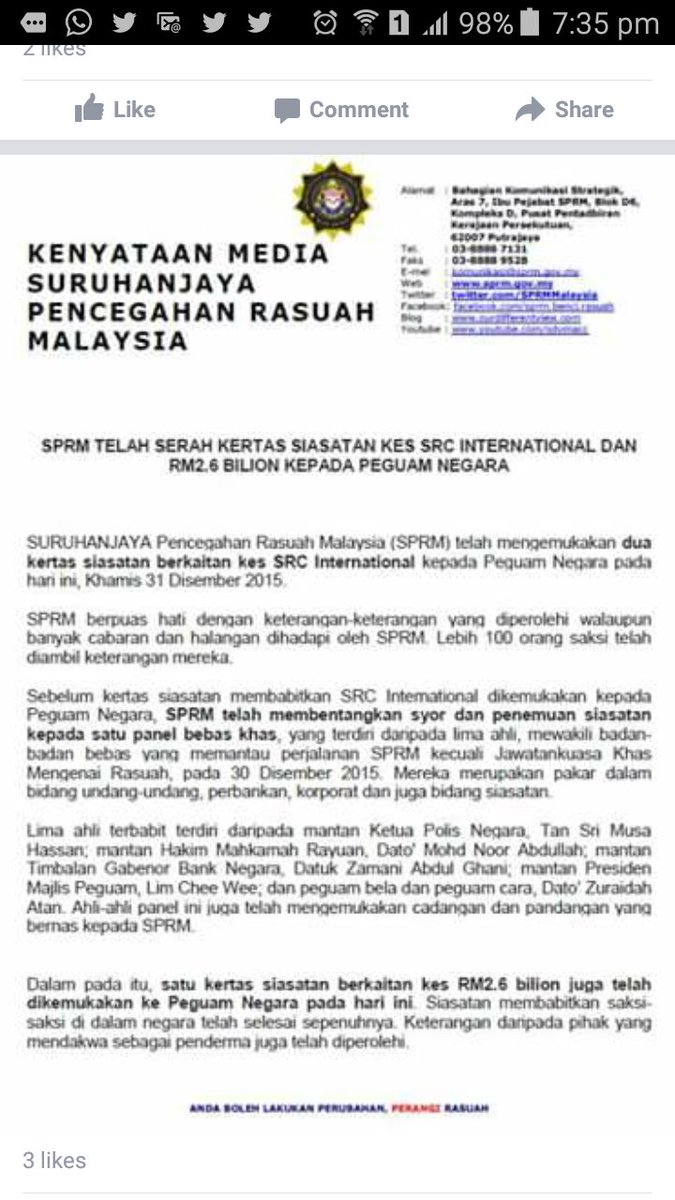
“It’s no use harping on the ‘feel good’ factor. The government must take the bull by the horns. It’s time to put our noses to the grindstone, work more, talk less. The 1MDB (1Malaysia Development Berhad) scandal and the RM2.6 billion political donation controversy will continue be the hot button issues in 2016.”
She recalled, in digressing a little, that a participant stood up at an economic conference in Berne, Switzerland, and berated Malaysia as a “pariah” country and then Prime Minister Mahathir Mohamad as worse than Iraqi President Saddam Hussein. Rafidah recalled that she restrained herself and explained that the Malaysian government did not need anybody’s validation to do what was necessary to save the country facing the contagion effects of the 1997/98 Asian Currency Crisis.
“We undertook what we believed were the most effective measures, although against conventional wisdom, for addressing the issues that Malaysia was facing then,” reminded Rafidah who was dubbed “the Iron Lady” in her day. “Malaysia succeeded in stemming the impact of the regional crisis and the ensuing recession to get back on the positive growth track.”
Rafidah conceded that Malaysia was not in an economic recession at the moment “but we need to be vigilant as things can continue to slide”.
She also cautioned against exploiting the situation for political gain. “No point finger-pointing and mudslinging. Enough of that! Please!”
“Now is the time for serious focus on economic governance and sanity in the political and social spheres.”
The former Wanita Umno Chief, who was also in the Cabinet at one time, cautioned against the government getting involved in business. “The government should be facilitating business and not getting involved in it. 1MDB, for all its billions, had not brought economic growth to the country.”
“The culture of Cash is King must never be allowed to take root in the country. If Cash is King, there would be greed, dishonesty, disregard for the rule of law, bribery and corruption. Money talks would be the motivation and culture.”
Malaysia, continued Rafidah, has faced many crises in the past – in the economic, political and social spheres – and there’s a need to learn from that past in terms of experience and crisis management.
“There’s a lack of coherence now in communicating with the public. There’s no credibility.”
She drew comparisons with 1997/1998 when the public placed their faith and trust in the government in spite of international criticisms. “The people knew the government was working to put the country back on its feet and bring back growth to the country.”
How I wish, the political leaders we elected into office listen to her advise too.
Putrajaya should stop blaming previous administrations for lopsided concessions and instead take responsibility for the matter, said veteran Umno leader Tengku Razaleigh Hamzah.
He said there was no sense pointing fingers at anyone because the current administration had received a mandate from the people to resolve all problems, including those caused by past contracts.
"Deals are deals. You cannot blame anyone. Even the deal made during Prophet Adam's time, we have to be responsible for that.
"We cannot blame others. We have been entrusted with the responsibility to solve problems, so we must try to solve them,"Tengku Razaleigh told a press conference today.
But he added that the government must still abide by what was agreed upon in the contract.
Yesterday, Deputy Prime Minister Datuk Seri Ahmad Zahid Hamidi admitted that the privatisation contracts were lopsided, but he urged the public not to blame the government as they were signed by the previous administration.
Zahid conceded that highway and independent power plant contracts, as well as the Express Rail Link (ERL) and the Kuala Lumpur International Airport (KLIA), were lopsided, which the current government was compelled to comply and follow.
"I don't want to name anyone. I don't want to lay blame on anyone. Don't blame us and compliment only the previous one (administration)," he was quoted as saying in reports.
Prime Minister Datuk Seri Najib Razak similarly blamed the controversial ERL train price hike on a lopsided agreement signed by Tun Dr Mahathir Mohamad's administration in 1997.
Najib said it was a long-term concession and he accepted the "legacy problem", but stressed that he was against the ERL price hike. – December 29, 2015.
......remember YBMs , MPs and ADUNs the buck stops at your collective desk! Don't agree? Please resign. Can't stand the heat? please leave the kitchen!
Hope the Pakatan Harapan will get their act together, once formidable, Umno is now disunited lead by a Presiden with dictator like tendencies and with twin baggage of RM2.6 B 'donation' and the 1MDB scandal which would not go away, the GE14 will be the best chance for Pakatan to win the GE, read Bridget Walsh analysis:
In search of hope for Pakatan Harapan Bridget Welsh Malaysiakini 22 Dec 2015 COMMENT Today marks the three-month anniversary of Pakatan Harapan – the revamped opposition coalition that is having difficulty getting off the ground. It is supposed to bring about hope, to galvanise like-minded Malaysians in the spirit of reform and cooperation to offer an electoral alternative. It is failing badly. As the year end approaches, it is valuable to examine why. Legacy issues The fact that Harapan was formed out of disappointment with Pakatan Rakyat has marked the new coalition. Attention still centres on who was responsible for Pakatan Rakyat’s collapse, with the blame game a persistent dynamic. At the same time, there is denial that Pakatan Rakyat is over, with some individuals and parties unwilling to let go of the past. These legacies of the past are debilitating Harapan. Rather than look forward, opposition parties in Harapan are continually focused on old wounds and battles. Fighting old friends now enemies is the norm, as old wounds are still raw. DAP attacks PAS. PKR insists that it can work with everyone (while in effect it is working with none as it stymies its supposed partners). Parti Amanah Negara attacks its old colleagues to show it is not PAS as it focuses on justifying itself. So much negative energy is being spent fighting rather than elsewhere. For now, it appears as if Harapan is divided rather than united. Some even doubt whether there is a working partnership. This is being compounded by a serious erosion of trust within the opposition itself. When members of a party have to use audio recordings of meetings to keep other members of the same party in check, something is wrong. Inside parties and among different parties, the trust erosion has corroded relationships. Ties are deteriorating further from persistent battling. As long as the opposition focuses on its past, it will not be able to move forward. Leadership This new opposition coalition suffers from a lack of viable leadership. Harapan has opted to have jailed Anwar Ibrahim as its leader, rather than offer a new option to the public. While the injustice surrounding the jailing of the former opposition leader is real, and the calls for his release have increased and will continue, the reality is that Anwar is not in a position to lead the opposition or to serve in a capacity as leader in Parliament or in government any time soon. Leaders matter – they win support and most importantly, they lead through making the hard decisions to bringing a diverse opposition together. Anwar’s lack of presence is being keenly felt, as evident of the infighting and lack of cohesion not only in his party PKR but in the opposition as a whole. If the opposition wants to be at all viable in the next election and Harapan is to be taken seriously, there needs to be alternative leadership that unifies the coalition, rather than divides it. This leader needs to be viable to the electorate as a whole. Voters need to know who they are voting for and why, as Harapan has to move from a holding pattern to moving ahead. The highest chances of releasing Anwar from jail lie with the opposition winning over the national government. A power game The leadership problem has worsened as individual parties have moved simultaneously into defensive silo mode, assuring that they strengthen their own party’s position for upcoming election. This is most obvious in the announcements of candidates in Sarawak, where rather than compromise or engage in quiet dialogue, the practice has been to demand in public and provoke. Each individual party wants to assure its fortunes and given the insecurity in the current political climate, the approach means look out for themselves rather than the opposition as a whole. The contraction of cooperation is tied to an ongoing fight for dominance and relevance in Harapan. Unlike with Pakatan Rakyat, where all three parties brought different strengths to the coalition, the focus now is on what weaknesses they have. DAP is seen as too Chinese, too arrogant. PKR is seen as too fragmented, too selfish. Amanah is seen as lacking a base and clear direction. All of the parties suffer from a lack of grassroots with the separation from PAS. Connectivity to the Malay grassroots is a particular problem. These shortcoming factors overshadow what they do bring to the partnership and the reality is that they are stronger together, rather than apart. The opposition parties are spending time in a power game to win dominance in Harapan for the case of PKR and DAP, and for Amanah to make itself relevant and to distance itself from perceptions that it is controlled by other parties in Harapan, notably DAP. As with the infighting tied to legacy issues, this expense of energy is also diverting the opposition from coalescing. Now, more than ever, as racial tensions and religious differences have heightened, the lack of a viable multi-racial alternative that brings Malaysians together rather than tear them apart is negatively shaping the political climate. Public credibility gap The biggest shortcoming of Harapan lies with the connection to voters. Three months on, it is not clear what Harapan stands for. It is just a vehicle for political power, a vehicle without the PAS wheel but essentially the same model without the hudud feature? Or is it something else? Is it a working multi-ethnic alternative? The only common ground that appears apparent to voters is that it is made of people who want to stay in office and in Penang and Selangor stay in government. What exactly is the common ground of Harapan? It cannot just be about winning an election to get support from voters. Harapan has yet to develop a clear platform or meaningfully engage with the public to explain what that platform might be. Within Harapan, Amanah in particular has yet to clearly define itself. The issues that voters care about are being ignored. Harapan is banking on the anger toward the incumbent Umno-led national government and hoping past support for the opposition will transfer to the new coalition. Both of these assumptions are flawed; Harapan underestimates the rise of apathy and underestimates the important pull of hope that the opposition provided to some Malaysian voters. It underestimates the impact of the delineation exercise, with many of the parties going along with the process and abandoning substantive electoral reform to position their individual party. It also underestimates the patronage power of an Umno-PAS relationship and overestimates the potential of these two Malay parties as reaching a level of cooperation that will alienate voters. Rather than work to win over the public, there is a sense of entitlement in Harapan that the public will come to them – a similar sentiment to that of BN that in many ways does little to differentiate Harapan from BN. More than ever, after a difficult year, Malaysians are searching for hope, for the promise of a different future. Sadly, Harapan has yet to offer this option. The potential of Harapan remains alive. Hard work and hard decisions are needed to make this substantive. Giving Malaysians a meaningful electoral alternative will not happen until Harapan works to fulfil its name, to move beyond the past, to sort out its present and outline a clear future. BRIDGET WELSH is a Senior Research Associate of the Center for East Asian Democracy at National Taiwan University, an Associate Fellow of The Habibie Center, a University Fellow of Charles Darwin University, and a Professor at Ipek University.
The controversial NSC Bill will be debated by the Senate soon, If you want to read the Bill in pdf form go here.
My concerns are as follows:
1. Haven't we enough laws to deal with terrorist organisations like ISIS etc? POTA, SOSMA and our battery of Penal Codes? And we have our deadly efficient PDRM Special Branch and Military Intelligence to ensure things do not get messy in our blessed country don't we?
2. Article 41 of our Perlembagaan clearly stated that the 'The Yang di-Pertuan Agong shall be the Supreme Commander
of the armed forces of the Federation'.
3. The NSC Bill give power to the Prime Minister directly over Armed Forces. The PM is not the Yang DiPertuan Agung he is a politician, put into office through a democratic process called the General Elections.
Our Perlembagaan say Agong is the Supreme Commander of the Armed Forces,but the NSC Bill will instead put them under control of PM.So how?